
The Ingredients of Accountability
What It Takes to Own Our Behavior—and What to Do When Someone Can’t

Wait. Did you mean can’t or won’t?
It’s an important question. We often think of accountability as a choice. Someone either chooses to acknowledge their behavior or refuses to. But what if, for some people, accountability isn’t simply a matter of willingness? What if it requires emotional and psychological capacities they haven’t fully developed or can’t reliably access?
This doesn’t mean people aren’t responsible for their behavior. And it certainly doesn’t mean we should tolerate being hurt. But understanding what accountability actually requires can change how we approach our relationships, including our relationship with ourselves.
When We’re Waiting for Someone to Take Accountability
Have you ever found yourself trying over and over again to get someone to understand how they’ve hurt you? Or perhaps you’ve been clear that a particular behavior isn’t okay with you, yet time and time again, it continues.
Maybe it’s a parent, sibling, in-law, partner, or someone else important in your life. Someone you desperately want to get it.
You’ve explained it differently, chosen your words more carefully, waited for a better moment, or tried to help them see things from your perspective. You may spend an enormous amount of time and emotional energy thinking about how to approach the next conversation. What should you say? How can you say it so they won’t get defensive? How can you finally help them understand?
And yet, somehow, the conversation ends in the same familiar place. They’re defending themselves, explaining their intentions, shifting the blame, or becoming so upset that you end up taking care of their feelings instead of having your own acknowledged. Or perhaps they seem to understand in the moment, but nothing actually changes.
Sometimes we spend years trying to help someone understand what they’ve done, believing that if we could just get them to see our experience, something would finally change.
But what if the difficulty isn’t in how we’re explaining it? What if we’re asking someone to do something they don’t currently have the capacity or willingness to do?
Recognizing this can be both painful and freeing. Painful because we may have to grieve the acknowledgment, understanding, or change we’ve been hoping for. Freeing because we can stop making our own well-being dependent on someone else’s ability to recognize our experience.
We can know that something hurt us without having to convince the other person that it happened. We can trust our experience even when someone else cannot validate it. And perhaps most importantly, we can begin making decisions about the relationship itself rather than continuing to wait for the other person to change.
Understanding Doesn’t Mean Abandoning Our Boundaries
This distinction is especially important. Understanding why someone struggles to take accountability does not mean we have to tolerate harmful behavior. Compassion and boundaries are not opposites.
We can recognize that someone’s defensiveness may come from shame and still decide that being blamed, dismissed, or mistreated isn’t acceptable. We can understand why a person behaves the way they do without continuing to participate in the same painful dynamic.
And we can stop trying to make someone acknowledge their behavior while still holding them responsible for how they treat us.
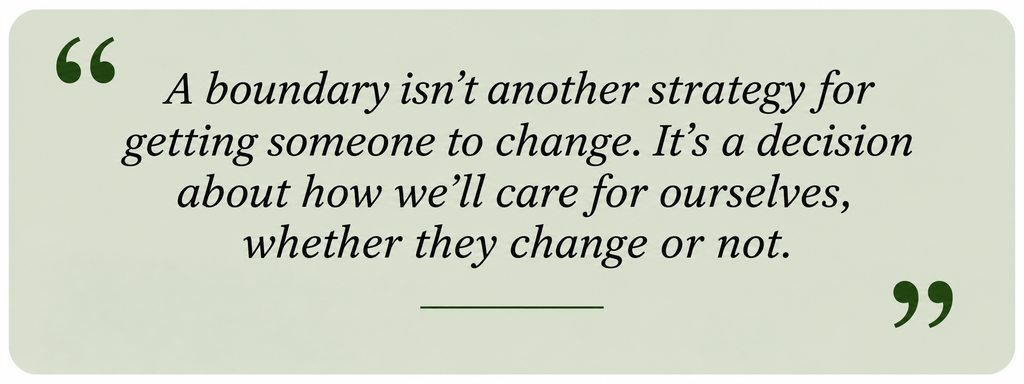
Accountability belongs to the person whose behavior caused harm. Boundaries belong to the person deciding what they will and will not participate in.
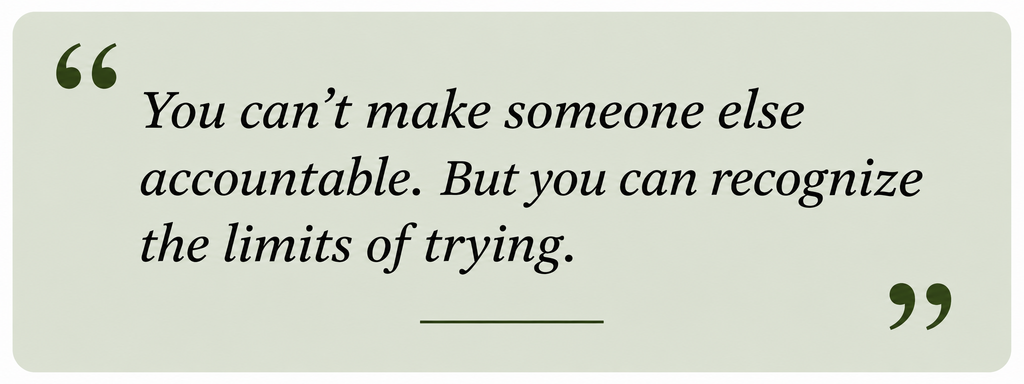
We cannot create accountability for someone else. We can invite it, communicate our experiences, and create opportunities for repair. But we cannot do the internal work that accountability requires on another person’s behalf.
What we can do is decide what is and isn’t okay for us. That might mean limiting certain conversations, changing our expectations, spending less time together, or reconsidering how much access someone has to our lives.
It’s also worth remembering that this probably isn’t how most of your relationships work. Think about the other people in your life—friends, family members, coworkers, or partners with whom you’ve navigated difficult conversations. You may not always agree, and you may occasionally hurt or misunderstand each other, but you’re able to talk about it. There’s room for different perspectives, acknowledgment, and repair. Something shifts because of the conversation.
You already know what that feels like. So why does it seem so different with this one person? Perhaps it’s worth considering that the difference isn’t in how you’re communicating, but in what the other person is able or willing to do with what you’re communicating.
Recognizing this can help us stop questioning whether we’ve said things the right way and begin asking a different question: What do I need to do differently if this relationship continues to function this way?
And here’s something particularly important: You don’t have to figure out whether someone can’t or won’t change before deciding what you’re willing to live with.
Understanding someone’s struggles may help us have compassion for them, but it doesn’t require us to keep putting ourselves in situations where we’re repeatedly hurt.
So What Does Accountability Actually Require?
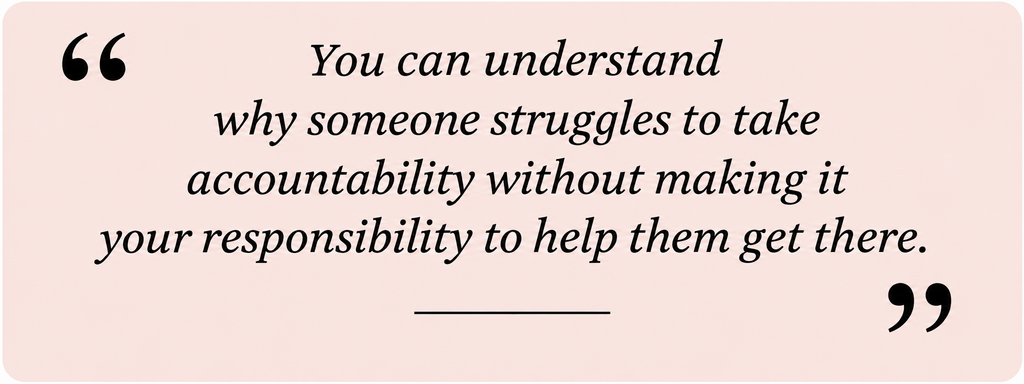
We tend to think taking accountability simply means admitting when we’re wrong. But genuine accountability asks us to do several emotionally difficult things at once. We have to recognize someone else’s experience, tolerate uncomfortable feelings about ourselves, and remain grounded enough to acknowledge that we may have caused harm.
For some people, these capacities are reasonably accessible. For others, particularly those who grew up in environments where mistakes were met with shame, criticism, rejection, or punishment, they can be much harder to access. Even people who generally have these abilities may struggle when their emotions become overwhelming.
Six Ingredients of Accountability
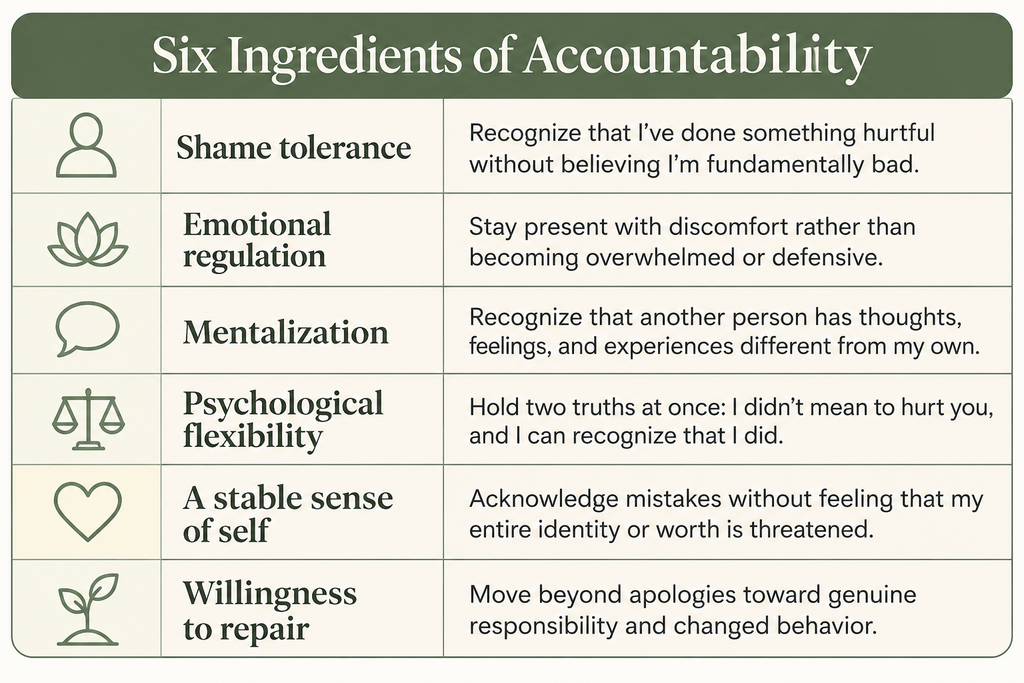
These ingredients are interconnected. Someone who experiences overwhelming shame may struggle to regulate their emotional response. When they’re emotionally overwhelmed, their ability to recognize another person’s perspective may narrow. And when they can’t recognize that perspective, taking responsibility becomes incredibly difficult.
Sometimes what looks like a refusal to care may actually be someone struggling to tolerate what acknowledging another person’s hurt brings up inside them. That doesn’t make the impact of their behavior any less real.
There’s also an important distinction between capacity and willingness. Someone may struggle to take accountability in the heat of a difficult conversation but be able to reflect and repair later. Others may have the ability to take responsibility but consistently choose not to. We can’t always determine which is happening from the outside.
What we can observe is whether someone demonstrates accountability over time and whether their behavior actually changes.
What If We’re the Ones Who Struggle With Accountability?
It’s easy to recognize defensiveness in someone else. It’s often harder to notice it in ourselves.
Most of us have moments when our defenses get in the way of taking responsibility. We may become overwhelmed with shame, feel misunderstood, or find ourselves explaining our intentions instead of listening to someone’s hurt. We may even recognize afterward that we weren’t as open or curious as we would have liked to be.
Rather than immediately judging ourselves, we can become curious about what happens inside us when someone says we’ve hurt them.
Do we feel shame, fear, anger, or an urgent need to explain ourselves? Does acknowledging a mistake feel like admitting we’re a bad person? Can we stay connected to our own experience while making room for someone else’s?
These questions aren’t about finding excuses. They’re about recognizing the emotional capacities we may need to strengthen in order to take responsibility without becoming overwhelmed.
For someone who struggles with shame, this may mean learning to separate their behavior from their worth. For someone who becomes emotionally overwhelmed, it may mean learning to recognize their nervous system’s response and finding ways to regulate before continuing a difficult conversation. And for someone who tends to focus on their own intentions, it may mean practicing curiosity about another person’s experience.
The encouraging part is that these capacities can be developed. Accountability is not simply a personality trait that we either have or don’t have. It’s something we can practice, strengthen, and become more capable of over time.
But there’s an important distinction between someone’s ability to grow and their willingness to do the work that growth requires. Developing these capacities generally begins with some degree of awareness that there’s something we need or want to change. That awareness may come through reflection, therapy, the consequences of our behavior, or a growing recognition that our familiar ways of responding aren’t serving us or our relationships.
And while other people can help us recognize these patterns, they cannot do that internal work for us.
In my experience as a therapist, meaningful change rarely happens because someone finally found the perfect words to explain a problem for the hundredth time. It happens when something shifts within the person themselves—when they begin to recognize the pattern, become curious about their own contribution to it, and develop a willingness to do something differently.
We can encourage that process, but we cannot manufacture it for someone else.
Compassion, Accountability, and the Freedom to Choose
Understanding what accountability requires can help us approach ourselves and others with greater compassion. We may recognize why someone becomes defensive or why acknowledging harm feels so threatening to them. We may also discover places where our own emotional responses interfere with our ability to take responsibility.
But understanding isn’t the same as excusing, and compassion doesn’t require us to abandon ourselves.
Someone’s inability to take accountability today doesn’t necessarily mean they’ll never develop that capacity. People can grow, learn, and change. But we don’t have to organize our lives around the possibility that someday they will.
Sometimes growth means learning to tolerate the discomfort of acknowledging that we’ve hurt someone and developing the capacity to repair. Other times, it means recognizing that someone may never offer us the acknowledgment or change we’ve been waiting for.
We can work toward greater accountability in ourselves while letting go of the responsibility to create it in someone else.
And sometimes the most meaningful change isn’t getting the other person to understand. It’s recognizing that we no longer need them to understand in order to make choices that are right for us.
